Example 02: Load a file, Perform a Non-sequential Ray Trace, Study Results.#
In this example, skZemax API is used to:
Load a native non-sequential Zemax example file:
Non-sequential\Miscellaneous\Digital_projector_flys_eye_homogenizer.zmx.A copy of this file will be saved as a new skZemax example file.
Run an NCE ray trace (using the pre-configured setup of the example file).
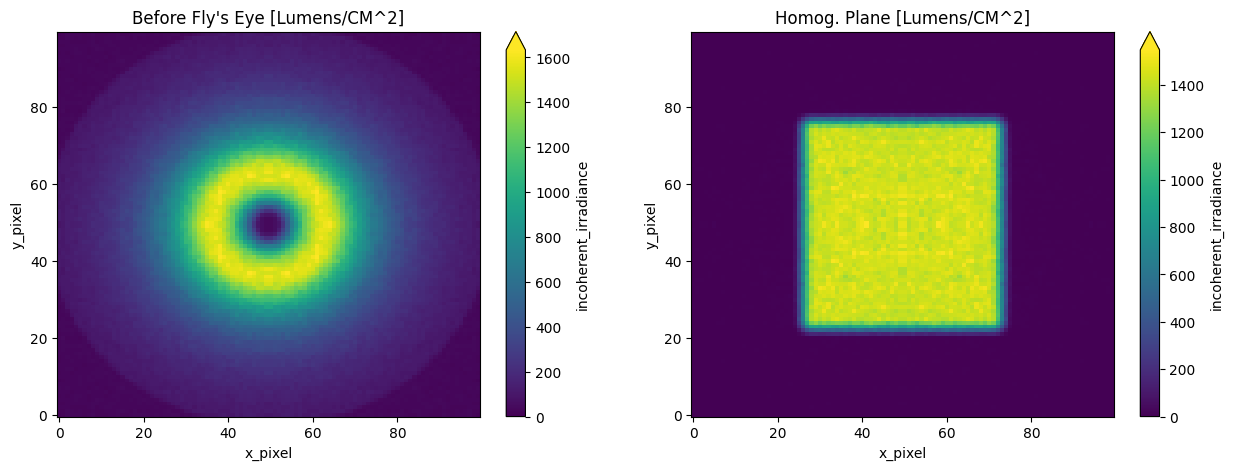
Capture two different NCE detectors in a python xarray format.
Visualize the system and plot the incoherent detector image.
Load the System and Run the Ray Trace#
from __future__ import annotations

import os

from skZemax.skZemaxClass import skZemaxClass

skZemax = skZemaxClass()
# Open the native Zemax example file (SamplesDir() function comes from the base stand-alone class of Zemax).
skZemax.Utilities_OpenZemaxFile(
    skZemax.SamplesDir()
    + os.sep
    + r"Non-sequential\Miscellaneous\Digital_projector_flys_eye_homogenizer.zmx",
    False,
)
# Run the ray trace
skZemax.NCE_RunRayTrace()
# Save a copy of the of this file.
skZemax.Utilities_SaveZemaxFileAs(
    skZemax.Utilities_skZemaxExampleDir() + os.sep + r"e02_SimpleRayTrace.zmx"
)
OpenZemaxFile ::  Opening Zemax file [C:\Users\dsl935\Documents\Zemax\SAMPLES\Non-sequential\Miscellaneous\Digital_projector_flys_eye_homogenizer.zmx].

NCE_RunRayTrace :: Starting ray trace....
|████████████████████████████████████████| 100% in 8.0s (0.13%/s)
NCE_RunRayTrace :: Done ray trace!

SaveZemaxFileAs :: Saving Current Zemax File As [E:\_OfficerRepositories\ZemaxRepos\skZemax\docs\source\Examples\e02_SimpleRayTrace.zmx].
Gather the detector information#
The file has two detectors:
index 4 (before the fly’s eye)
index 7 (Homog. Plane)
We can locate these indices in skZemax API with skZemax.NCE_GetDetectorLocations()
# Get xarray of detector data
det_index = skZemax.NCE_GetDetectorLocations()
print(f"Detectors indices: {det_index}")
detector1_xr = skZemax.NCE_GetDetectorComplete(det_index[0])
detector2_xr = skZemax.NCE_GetDetectorComplete(det_index[1])
Detectors indices: [4, 7]
Make a Visualization of the System#
# Make a visualization of the system
skZemax_example_dir = skZemax.Utilities_skZemaxExampleDir()
skZemax.Visualization_NSC_3DViewer(
    saved_image_location=skZemax_example_dir
    + os.sep
    + r"e02_SimpleRayTrace_3DView.png",
    color_rays_by_NSC_options="SegmentNumber",
)
Close down Zemax#
# No longer need the skZemax class, cleaning it up
del skZemax
skZemax = None
Display the System and Study the Detector Images#
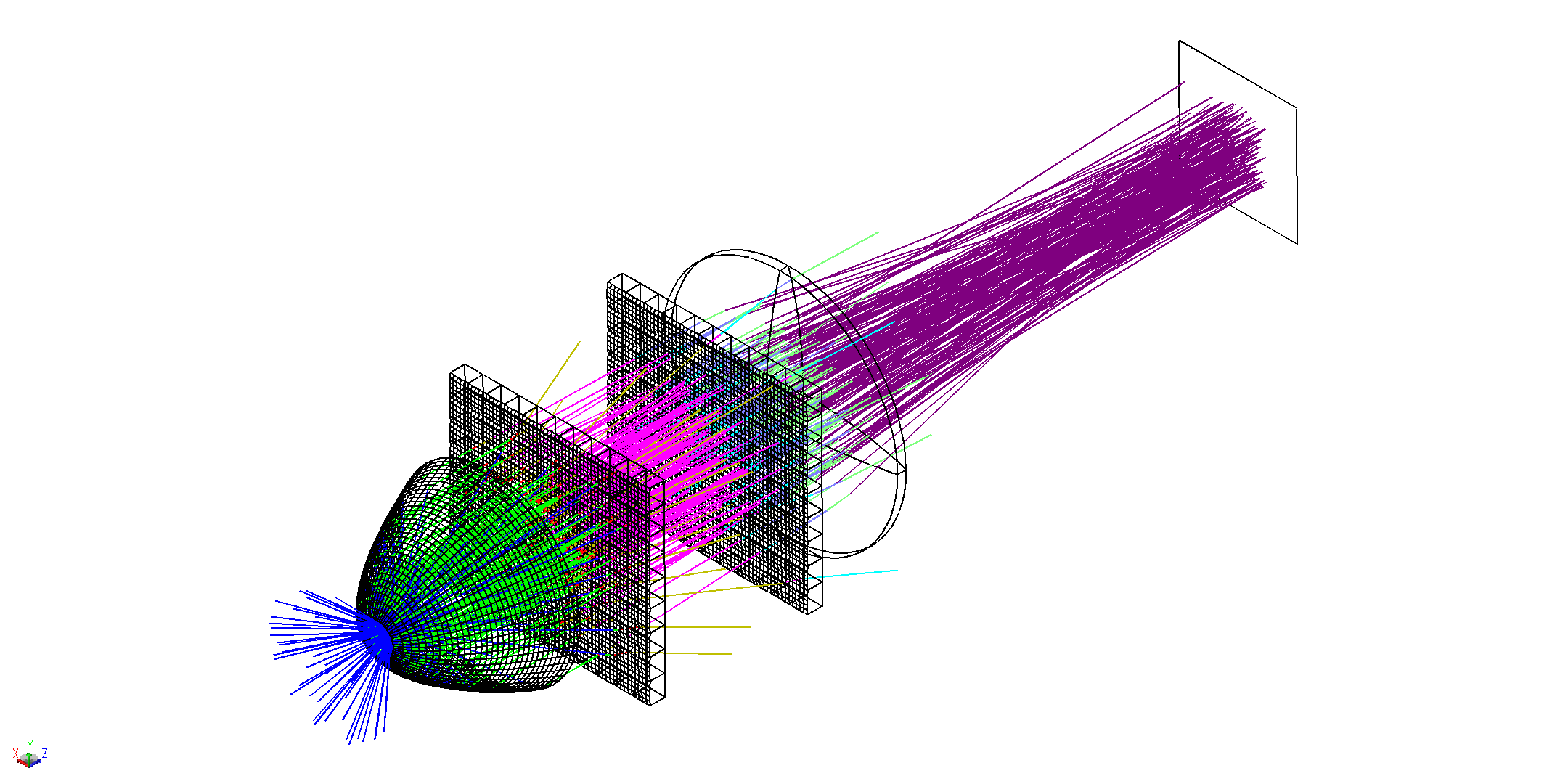
# Display the 3D view
from IPython.display import Image

Image(
    filename=skZemax_example_dir + os.sep + r"e02_SimpleRayTrace_3DView.png", width=800
)
import matplotlib.pyplot as plt

fig, ax = plt.subplot_mosaic([["d1", "d2"]], figsize=(15, 5))
detector1_xr.incoherent_irradiance.plot.imshow(
    ax=ax["d1"], vmin=0, vmax=float(detector1_xr.attrs["Peak Incoherent Irradiance"])
)
ax["d1"].set_title(
    "{} [{}]".format(
        detector1_xr.attrs["Comment"], detector1_xr.attrs["Irradiance Units"]
    )
)
detector2_xr.incoherent_irradiance.plot.imshow(
    ax=ax["d2"], vmin=0, vmax=float(detector2_xr.attrs["Peak Incoherent Irradiance"])
)
ax["d2"].set_title(
    "{} [{}]".format(
        detector2_xr.attrs["Comment"], detector2_xr.attrs["Irradiance Units"]
    )
)
plt.savefig(skZemax_example_dir + os.sep + r"e02_SimpleRayTrace_Detector.png")
print(detector1_xr)
<xarray.Dataset> Size: 965kB
Dimensions:                       (y_pixel: 100, x_pixel: 100, y_angle: 100,
                                   x_angle: 100)
Coordinates:
  * y_pixel                       (y_pixel) int64 800B 0 1 2 3 4 ... 96 97 98 99
    y_distance                    (y_pixel) float64 800B -22.0 -21.56 ... 22.0
  * x_pixel                       (x_pixel) int64 800B 0 1 2 3 4 ... 96 97 98 99
    x_distance                    (x_pixel) float64 800B -22.0 -21.56 ... 22.0
  * y_angle                       (y_angle) int64 800B -90 -88 -86 ... 86 88 90
  * x_angle                       (x_angle) int64 800B -90 -88 -86 ... 86 88 90
Data variables:
    power                         (y_pixel, x_pixel) float64 80kB 0.02891 ......
    incoherent_irradiance         (y_pixel, x_pixel) float64 80kB 14.93 ... 1...
    incoherent_radiant_intensity  (y_pixel, x_pixel) float64 80kB 0.0 ... 0.0
    incoherent_radiance_position  (y_pixel, x_pixel) float64 80kB 2.376 ... 2...
    incoherent_radiance_angle     (y_angle, x_angle) float64 80kB -0.0 ... -0.0
    detector_fov_angles           (y_angle, x_angle) float64 80kB 127.3 ... 1...
    coherent_irradiance           (y_pixel, x_pixel) float64 80kB 0.9749 ... ...
    coherent_phase                (y_pixel, x_pixel) float64 80kB 99.88 ... 9...
    coherent_real                 (y_pixel, x_pixel) float64 80kB -0.007457 ....
    coherent_imag                 (y_pixel, x_pixel) float64 80kB 0.0428 ... ...
    coherent_amp                  (y_pixel, x_pixel) float64 80kB 0.04344 ......
    coherent_power                (y_pixel, x_pixel) float64 80kB 0.001887 .....
Attributes: (12/48)
    Power Units:                           Lumens
    Irradiance Units:                      Lumens/CM^2
    Radiant Intensity Units:               Lumens/Sr
    Radiance Units:                        Lumens/CM^2/Sr
    Phase Units:                           Degrees
    Distance Units:                        Millimeters
    ...                                    ...
    X Angle Min:                           -90
    X Angle Max:                           90
    Y Angle Min:                           -90
    Y Angle Max:                           90
    Polarization:                          0
    Mirroring:                             3